Flydubai FZ1073: Cockpit Stabbing Forces Diversion to Saudi
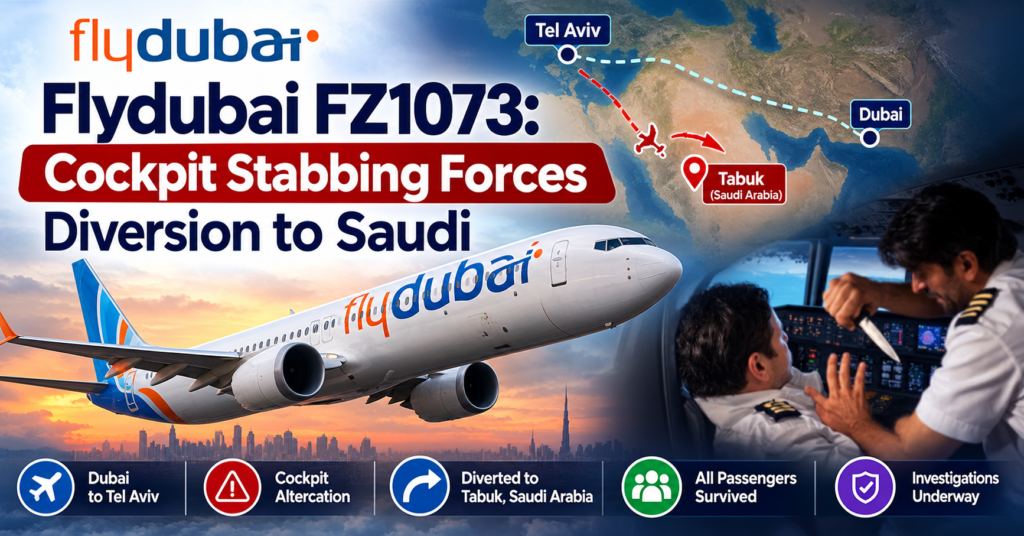
A routine overnight Flydubai service from Dubai to Tel Aviv turned into a mid-air emergency on Wednesday, 30 September 2026, after one pilot stabbed the other in the cockpit in what Israeli officials are calling an attempted attack. The Boeing 737 MAX 8, carrying around 174 people, was diverted and landed safely at Tabuk in northwestern Saudi Arabia.
Passengers and crew intervened to subdue the attacker, and a second set of Flydubai pilots travelling on board brought the aircraft down. Everyone on the flight survived, though both pilots were injured and one remains hospitalised. The incident has triggered investigations in two countries and renewed scrutiny of flight security in the region.
What Happened Aboard Flight FZ1073
Flight FZ1073 took off from Dubai bound for Ben Gurion Airport near Tel Aviv, flying over Jordanian airspace. According to Israeli officials, a struggle broke out in the cockpit when one pilot stabbed the other, and the aircraft dropped nearly 14,000 feet in under 30 seconds during the altercation.
Flydubai’s own statement was more measured than the Israeli government’s account, describing the event only as an “incident” and later an “altercation” on the flight deck, without confirming a stabbing. The airline said the aircraft was secured by on-duty crew who happened to be travelling on the flight and that it landed safely at Tabuk, with all passengers accounted for.
Also Read- Trump and Six AI Giants Sign Voluntary Safety Pact at White House
How the Emergency Unfolded
Flight tracking data shows the aircraft’s transponder switched first to code 7700, the general emergency signal, and then roughly seven minutes later to code 7500, which specifically signals unlawful interference, a code associated with hijacking. Israel responded by scrambling fighter jets as the situation developed.
| Time (GMT) | Event |
|---|---|
| 03:05 | Flight FZ1073 departs Dubai |
| 05:21 | Altitude fluctuations begin |
| 05:22 | Aircraft drops more than 14,000 ft in under 30 seconds |
| 05:31 | Transponder signals code 7700, general emergency |
| 05:38 | Transponder signals code 7500, unlawful interference |
| 06:45 | Aircraft lands safely at Tabuk |
How the Attack Was Stopped
The injured captain managed to reach the cockpit door release despite his wounds, allowing passengers and crew to reach the attacker. Israeli officials say this action by the wounded pilot prevented what could have become a far more serious disaster.
Passenger Dalia Shpigel told an Israeli newspaper that people near the front of the cabin broke into the cockpit once they sensed the aircraft losing control. Another passenger, Yitzhak Lieber, said in a video message to his family that the attacker had been overpowered and restrained. With the cockpit secured, a second pair of off-duty Flydubai pilots who were travelling on the flight took over and flew the aircraft to Tabuk.
The Injured Pilot: An Indian National Praised as a Hero
The captain was identified by Israeli officials and India’s embassy in Saudi Arabia as Smit Machchhar, an Indian national. He was taken to a hospital in Tabuk and was reported to be in stable condition, with the embassy saying it remained in contact with both his family and Saudi authorities.
Both Israeli Prime Minister Benjamin Netanyahu and Indian Prime Minister Narendra Modi publicly praised Machchhar’s actions, with Modi calling him a “hero” in a post on social media. Netanyahu later met with one of the passengers who had helped subdue the attacker and thanked those involved for what he described as preventing a far worse outcome.
What Is Known About the Suspect
Officials have not released the attacking pilot’s full identity, but an Israeli official speaking to Reuters identified him as an Omani national serving as co-pilot on the flight. Netanyahu said the suspect was being questioned in Saudi Arabia and was expected to eventually be moved to the UAE, where he was based.
Israel’s Defence Minister Israel Katz described preliminary findings as pointing to an attempt to crash the plane and kill everyone aboard, calling it an attempted “jihadist terror attack.” Netanyahu was more cautious about assigning a motive, telling a US broadcaster it was too early to say whether Iran or any other actor was involved, though he said investigators would likely have answers soon.
Investigations Launched in the UAE and Israel
The UAE’s Attorney General, Hamad Saif al-Shamsi, ordered a formal investigation into the incident, with his office saying the inquiry would examine the circumstances, motives, and any possible links to terrorism or prior planning. Netanyahu said Israel expected to participate in the investigation alongside Saudi and Emirati authorities, given the number of Israeli citizens on board.
In the meantime, Reuters reported that Netanyahu directed Israeli authorities to step up security on both Israeli and non-Israeli carriers in the wake of the incident, while Flydubai urged the public to avoid speculating about the cause while the facts were still being established.
Political Reaction Inside Israel
The incident has become entangled in Israeli politics ahead of a legislative election scheduled for 27 October. Opposition leader Yair Lapid accused allies of the prime minister of trying to link the attack to unrelated prior security warnings, saying on social media that a specific standing warning about threats abroad had nothing to do with this incident. He also argued that Netanyahu was seeking credit for the actions of ordinary passengers rather than his own government’s preparedness.
Netanyahu’s office did not directly respond to Lapid’s comments but continued to focus its public statements on the passengers and crew who intervened, along with the condition of the injured pilot.
Clearing Up a Second-Flight Rumour
Hebrew-language media outlets initially reported that a second Flydubai flight, FZ1081, had also turned back toward Dubai. The Times of Israel later reported this was incorrect, attributing the error to a likely glitch on flight-tracking websites, and said FZ1081 had issued no emergency signal and continued on to Tel Aviv without disruption.
Why This Incident Matters
A cockpit attack by one of a plane’s own pilots is an unusually rare and alarming category of aviation incident, since cockpit access is normally the last line of defence against interference with an aircraft. The fact that the plane was travelling between the UAE and Israel, two countries that normalised diplomatic relations in 2020 and have since seen growing tourism and flight traffic between them, adds a layer of regional sensitivity to what might otherwise be treated purely as an aviation security story.
The timing, just before the third anniversary of the 7 October 2023 Hamas-led attacks on southern Israel, has also shaped how the incident is being discussed in Israeli politics, even though officials have stressed that no motive has yet been formally established.
What Happens Next
Flydubai sent replacement aircraft to Tabuk, and passengers continued on to Tel Aviv later the same day, with Netanyahu reportedly at Ben Gurion Airport to greet them on arrival. Both the UAE and Israel have signalled they intend to pursue formal investigations, and the attacking pilot is expected to face legal proceedings once the Saudi authorities conclude their initial inquiry.
Airlines and aviation regulators in the region are likely to review cockpit security protocols in light of the incident, particularly given that the attacker was a member of the flight crew rather than an external threat. Further official findings on motive are expected as the UAE-led investigation progresses.
Frequently Asked Questions
What flight was involved in this incident?
Flydubai flight FZ1073, a Boeing 737 MAX 8 travelling from Dubai to Tel Aviv with around 174 people on board, was diverted after a cockpit altercation on 30 September 2026.
Where did the flight land?
The aircraft landed safely at Tabuk Airport in northwestern Saudi Arabia after being diverted from its original route to Tel Aviv.
Who was the injured pilot?
The injured captain was identified as Smit Machchhar, an Indian national, who was treated at a hospital in Tabuk and praised by Israeli and Indian leaders for his actions during the incident.
Who has been blamed for the attack?
An Israeli official identified the co-pilot involved as an Omani national. Authorities have not confirmed a motive, and the individual is being investigated by Saudi authorities.
Was a second Flydubai flight also affected?
No. Reports that a second flight, FZ1081, had turned back were later found to be inaccurate, reportedly due to a flight-tracking data error, according to the Times of Israel.