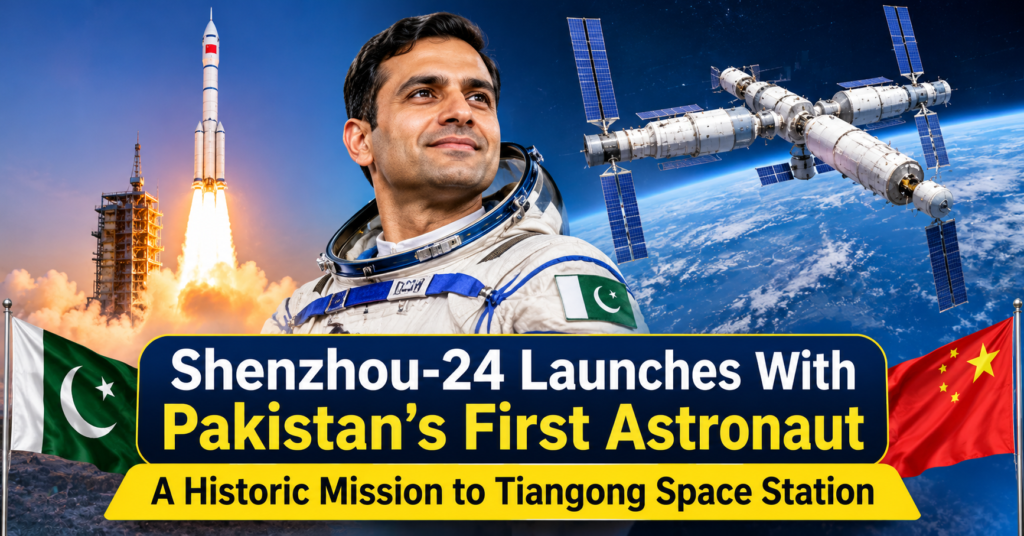
China launched its Shenzhou-24 crewed spacecraft on Wednesday, 25 November 2026, carrying Pakistan’s Muhammad Zeeshan Ali into orbit. He is the first Pakistani in space and the first foreign astronaut to join a Chinese crewed mission to the Tiangong space station. The flight marks a major moment for Pakistan’s space ambitions and for China’s push for international space partnerships.
Liftoff From the Gobi Desert
Shenzhou-24 lifted off from the Jiuquan Satellite Launch Center in northwest China at 8:18 a.m. Beijing time on Wednesday. China’s crewed space agency declared the launch a complete success.
The spacecraft reached its destination within hours. Reports said Shenzhou-24 docked with the Tiangong space station at 11:56 a.m. Check official updates for the exact docking time.
Meet the Shenzhou-24 Crew
- Tang Hongbo, commander: He flew on Shenzhou-12 and Shenzhou-17, and becomes the first astronaut to visit Tiangong three times.
- Wu Yi, flight engineer: He is from China’s third group of astronauts and is making his first flight.
- Muhammad Zeeshan Ali, payload specialist: The 40-year-old pilot will work as a payload specialist and is set to stay at the station for 5 to 10 days, conducting experiments.
Ali flies mainly as a scientist, not a spacecraft operator. His role focuses on scientific experiments rather than operating the spacecraft.
Mission Snapshot: Key Facts
- Launch date and time: 25 November 2026, 8:18 a.m. Beijing time
- Rocket: Long March-2F
- Destination: China’s Tiangong space station
- First: first Pakistani in orbit and first foreign astronaut on Tiangong
- Ali’s stay: about a week, within a 5 to 10 day window
- Chinese crew stay: Tang and Wu are expected to remain for a longer rotation
What Ali Will Do in Orbit
Science fills his short schedule. The mission aims to host four biotechnology experiments developed by universities in Pakistan, according to an official at Pakistan’s space agency. Reports say these include studies of photosynthesis in bacteria and the effect of radiation and microgravity on seeds. The wider Chinese crew will also run experiments in areas such as aerospace medicine and combustion.
Also Read- Strong 6.8 Earthquake Rattles Central Peru: Lima Residents Rush Outdoors, No Damage Reported So Far
In His Own Words: Ali and Pakistan’s Reaction
Ali spoke to reporters before the flight. He said he was not flying for himself and that he carries the name of Pakistan on his shoulder. He also said his first flight represents not only himself but also his country.
Pakistan’s leaders welcomed the launch. Prime Minister Shehbaz Sharif called it a source of national pride and said he hoped it would inspire young Pakistanis. The flight is a big boost for a country that has no crewed spacecraft of its own.
How a Pakistani Astronaut Reached Tiangong
The mission grew from a formal agreement. It stems from a bilateral space cooperation agreement signed by China and Pakistan in February 2025. Ali and fellow candidate Khurram Daud trained in China for seven months, and Ali was ultimately selected. Ali is a former military fighter pilot. Learning Mandarin was reportedly one of his hardest challenges.
Why the Flight Carries Global Weight
China wants Tiangong to serve as an international research platform. Beijing is promoting the station as a hub for international cooperation, while the NASA-led International Space Station faces possible retirement by 2030. Inviting a foreign astronaut is a visible step toward that goal. China also aims to land its astronauts on the moon by 2030.
For Pakistan, the flight is a milestone in science and national pride. For the wider region, it shows how space has become a stage for diplomacy. India, with its own Gaganyaan programme, is also building human spaceflight capability, so regional space competition and cooperation are both in focus.
What Happens Next
- Station work: Ali will run his experiments during his short stay on Tiangong.
- Return to Earth: He will come home after about a week with two crew members who have been at the station since May.
- Chinese crew rotation: Tang and Wu will stay on for a longer period of research and station operations.
- More foreign visitors: China has signalled interest in opening the station to other countries, though no further names are confirmed.
- Research results: Pakistani universities may share findings once samples return to Earth.
Quick Answers on Shenzhou-24
Who is Pakistan’s first astronaut?
Muhammad Zeeshan Ali, a 40-year-old former fighter pilot.
When did Shenzhou-24 launch?
At 8:18 a.m. Beijing time on Wednesday, 25 November 2026.
How long will Ali stay in space?
About a week, within a window of 5 to 10 days.
Who else is on the crew?
Commander Tang Hongbo and flight engineer Wu Yi.
Why is this flight historic?
Ali is the first Pakistani in orbit and the first foreign astronaut to board Tiangong.
What will he study?
Biotechnology experiments from Pakistani universities, including work on bacteria and seeds.