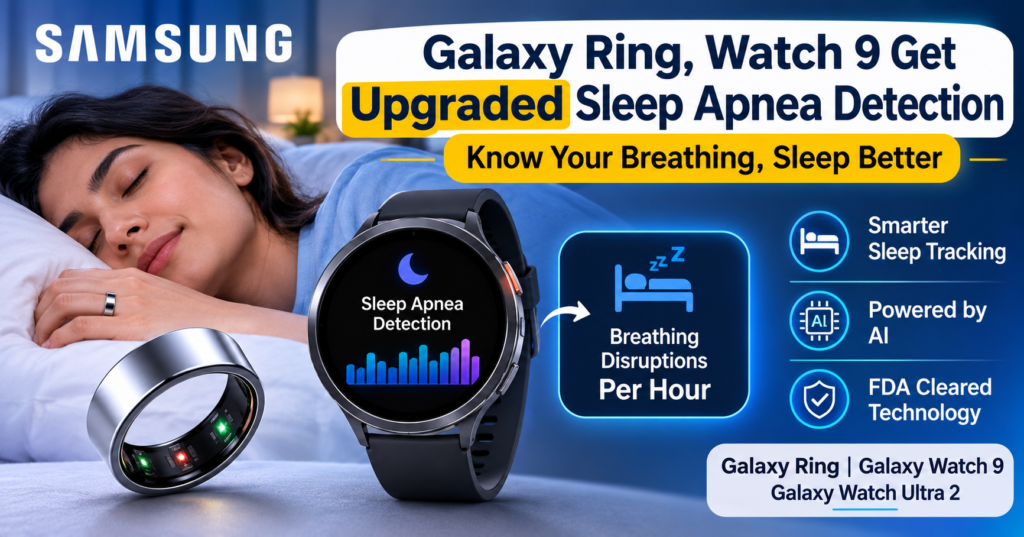
Samsung has begun rolling out an upgraded sleep apnea feature to the Galaxy Ring, Galaxy Watch 9 and Galaxy Watch Ultra 2 through its Samsung Health Monitor app. The update goes beyond a simple risk flag and estimates how many times your breathing is disrupted each hour you sleep.
Several outlets say this makes the Galaxy Ring the first smart ring with a regulator-cleared sleep apnea risk feature.
What Changed in the Update
Engadget reports that the upgraded feature uses AI to detect the number of breathing disruptions per hour of sleep. HIT Consultant says it moves from basic risk categorisation to calculating that hourly estimate. Samsung says the deeper data can help people have better conversations with a doctor.
The feature builds on Samsung’s earlier sleep apnea tool, which won the FDA’s De Novo authorisation in February 2024, according to Engadget. Samsung says the upgraded version has now cleared both the US Food and Drug Administration and South Korea’s Ministry of Food and Drug Safety.
Where and When It Is Rolling Out
Reports differ slightly on the rollout. Android Authority says the upgraded detection is rolling out across the United States and South Korea. Other outlets, including BGR and Beebom, said the first phase is in South Korea from November 2026. GSMArena later reported the feature as now available on the Galaxy Ring and Watch 9.
I found no announcement of availability in India, so Indian users should not assume they can use it yet. Check the Samsung Health Monitor app and Samsung India’s announcements.
Which Devices Support It
The feature runs on Galaxy Watches with Wear OS 7.0 and One UI 9 Watch, plus the Galaxy Ring. The first group of devices is:
- Galaxy Ring
- Galaxy Watch 9
- Galaxy Watch Ultra 2
SamMobile’s report, which you supplied, says the Galaxy Watch 7, Watch 8, Watch 8 Classic and the 2024 and 2025 Galaxy Watch Ultra models will get the feature through a later update. Samsung has not given dates for those updates in the coverage I saw. Users with both a Ring and a compatible watch can choose either device for detection, depending on which is more comfortable at night.
Requirements and Limits
Samsung says the feature needs at least five hours of sleep on two nights within a 10-day period, according to Engadget and SammyFans. It is for adults aged 18 and older who have not been diagnosed with sleep apnea before, per Beebom. It needs the Samsung Health Monitor app on a compatible Galaxy phone.
The feature is a screening tool. It does not diagnose sleep apnea, and anyone with symptoms or concerns should see a doctor.
What Samsung Has Said
At the Galaxy Watch 9 launch, Samsung digital health lead Sharanya Desai said that starting this fall, the Galaxy Ring would be the “first and only FDA-cleared over-the-counter ring device” for sleep apnea risk detection, according to BGR. Samsung also says the Ring’s light design makes it easier to wear through the night, GSMArena reports.
Why It Matters
Sleep apnea, a condition where breathing repeatedly stops and starts during sleep, often goes undetected because people are asleep when it happens. A comfortable wearable that screens for it could encourage more people to seek a proper medical assessment. A ring may suit people who find a watch uncomfortable in bed.
What Happens Next
Samsung is expected to extend the feature to older Galaxy Watches and, over time, to more countries as approvals come through. Regulatory approvals differ by market, so availability will vary. Check Samsung’s official announcements for India.
FAQs
What is new in the upgraded feature?
It estimates the number of breathing disruptions per hour of sleep, not just a general risk level.
Which devices get it first?
Galaxy Ring, Galaxy Watch 9 and Galaxy Watch Ultra 2.
Will older Galaxy Watches get it?
Samsung says the Watch 7, Watch 8 and Ultra models will receive it later via software updates.
How much sleep data is needed?
At least five hours of sleep on two nights within a 10-day period.
Is it available in India?
I found no announcement of India availability.
Does it diagnose sleep apnea?
No. It screens for risk, and a doctor must make a diagnosis.