
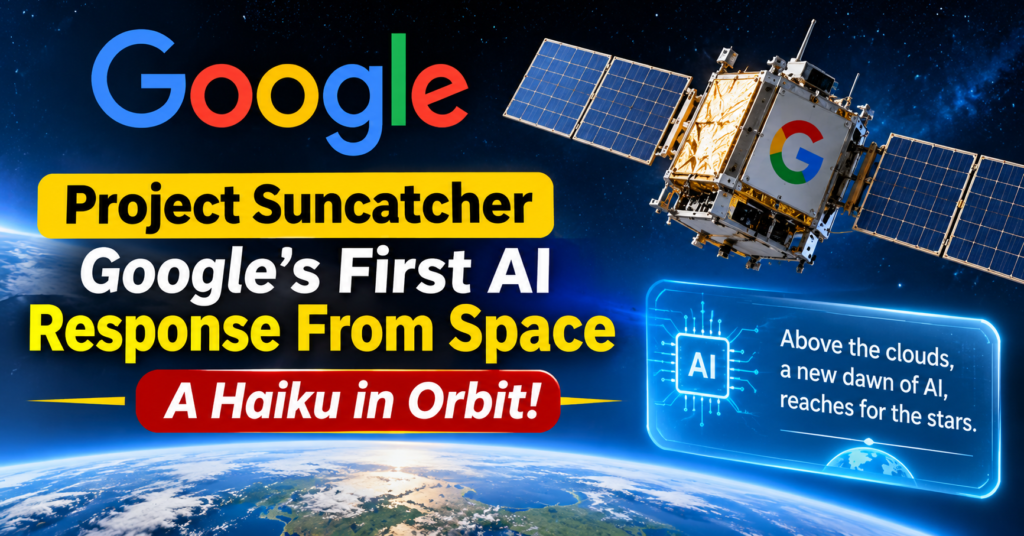
Google has run an AI model on a satellite in orbit and received a complete response back on Earth. The result, reported on 30 and 31 October 2026, is an early but concrete step in Project Suncatcher, a research effort to find out whether space could one day host large-scale AI computing.
The first output was a haiku about being in space.
What Happened in Orbit
Google launched the prototype satellite on 1 October 2026. Over the following weeks, the team completed commissioning checks, including powering up the host and TPU trays and running early machine learning tests. A TPU is a Tensor Processing Unit, Google’s custom AI chip.
During a ground-station pass, the team sent a prompt to the onboard Gemma 4 open model, asking for a haiku about space. The satellite sent the response back as it passed over Svalbard, Norway, according to Google’s account. The team then tested the system with space-themed limericks and prompts asking the model to report the technical status of the satellite’s systems.
What Google Has Said
Sundar Pichai, Google’s CEO, announced the result on X and called it a “hello world” milestone for Project Suncatcher. He said the team sent a command to orbit, booted up the TPU, ran the prompt and received its first complete response on Earth.
Travis Beals, a senior director at Google who leads the project, described the test in Google’s blog. He said the satellite launched on 1 October and that the first prompt went to the onboard Gemma 4 model.
Also Read- iPhone Air 2 Tipped for Dual 48MP Cameras, 120Hz Display and 2nm Chip: What the Latest Leak Says
Launch and Hardware
The satellite launched on a SpaceX Transporter-18 rideshare mission from Vandenberg Space Force Base in California, according to Free Press Journal. Google built it with Planet Labs, and it carries four TPUs, according to reports. After launch, Beals said the team had confirmed contact and the satellite was operating as expected.
Why Google Is Looking at Space
Google first described the idea in late 2025. It argues that satellites in low Earth orbit could get near-constant sunlight and might generate several times more solar power than panels on the ground. Google has put that figure at up to eight times, though this remains a company projection. Training and running AI models takes enormous amounts of electricity, which has pushed technology companies to look for new power and cooling options.
Project Suncatcher imagines groups of satellites linked together to handle larger AI workloads. A single prototype writing a haiku is far from that, and Google calls it a long-term research effort.
The Challenges Ahead
Space is a harsh place for chips. Radiation can damage electronics, and getting rid of heat in a vacuum is difficult. Google says the next phase will test how the TPUs behave under thermal stress and radiation in orbit, to find out whether they can run workloads reliably.
Other open questions include cost, launch capacity, communication links and how well satellites can work together at scale. Google has not made any claim about when, or whether, space-based AI data centres will become practical.
Why It Matters
Whether space can ease the energy demands of AI is one of the biggest open questions in the industry. This test does not answer it, but it confirms that Google’s chip can boot, run a model and talk to the ground from orbit. For readers in India, where data centre power and land costs are growing concerns, it signals how far the largest tech companies are willing to look for options.
What Happens Next
Google says successful radiation and thermal testing would clear the way for its next milestone, two interconnected prototype satellites with Planet Labs in 2027. Pichai has previously said by early 2027. Further tests, results and any technical findings from the current satellite are expected to follow.
FAQs
What is Project Suncatcher?
A Google research effort to test whether satellites with TPUs could run AI workloads in space.
What happened on 30 October?
Google announced that its prototype satellite ran an AI model in orbit and sent a response back to Earth.
What model ran in space?
Gemma 4, one of Google’s open models.
When did the satellite launch?
On 1 October 2026.
Who built the satellite?
Google, working with Planet Labs.
What comes next?
Radiation and thermal testing, then two linked prototype satellites planned for 2027.






[…] Also Read- Google Runs an AI Model on a Satellite in Orbit: Project Suncatcher Hits Its First Milestone […]