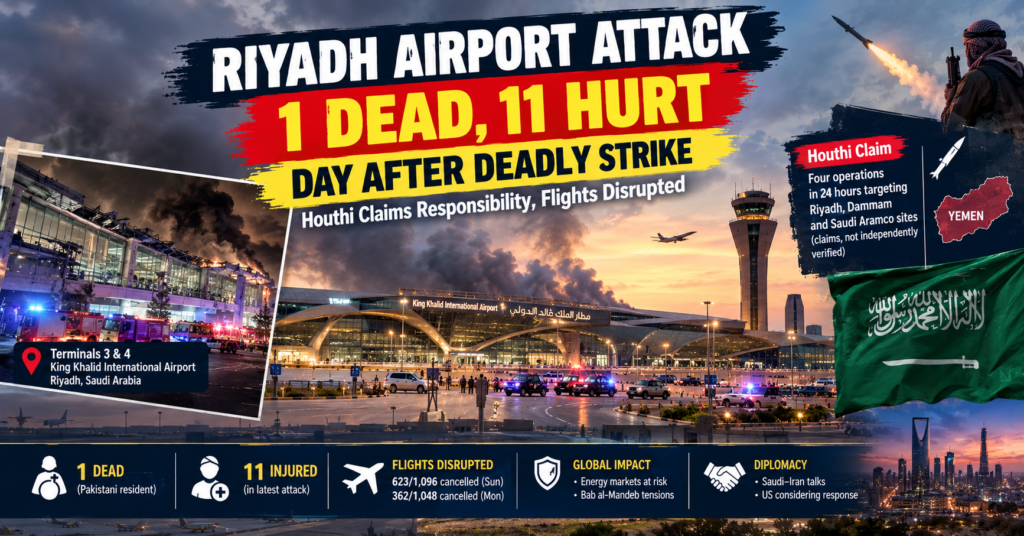
A projectile struck King Khalid International Airport in Riyadh on Sunday evening, October 11, 2026, killing one person and injuring 11, according to Saudi Arabia’s General Authority of Civil Aviation (GACA). The authority said the person killed was a Pakistani resident. The strike came a day after a Houthi missile attack on the same airport killed 12 people and wounded 309, a toll that rose to 13 when an injured Indian national later died.
The attacks have disrupted flights across Saudi Arabia, deepened fears of a wider regional conflict and raised the possibility of US involvement.
What Happened on Sunday
GACA said the projectile hit terminals 3 and 4, which serve domestic flights. The injured were taken to several hospitals, and the authority said damage assessments and safety inspections were under way, according to Al Jazeera, which cited AP and Reuters.
A witness aboard a taxiing aircraft told Reuters that a projectile struck the tarmac next to several parked planes at about 8:30 pm local time, causing a fire. The aircraft returned to the gate, and passengers were told to disembark and leave.
Yemen’s Houthis claimed responsibility late on Sunday. Military spokesman Yahya Saree said the group carried out four operations targeting Riyadh’s airport over the previous 24 hours, and that it also targeted Dammam airport and two facilities belonging to Saudi Aramco, according to Khaleej Times. These are the group’s claims, and the reports reviewed did not independently confirm the Dammam and Aramco strikes.
Also Read- India’s Semiconductor Push: How India Is Building Its Position in the Global Chip Industry
The Saturday Attack That Preceded It
On Saturday, October 10, a missile hit the same airport, killing at least 12 people and wounding 309, some critically, GACA said. Al Jazeera reported that the dead included four Saudi citizens and two Bangladeshis, and that victims overall included four Saudis and eight foreigners. India’s embassy in Saudi Arabia said on Sunday that an Indian citizen injured in that attack had died, bringing the toll to 13.
Al Jazeera described it as the deadliest attack in Saudi Arabia since the US-Israel war on Iran began in late February. Saudi Arabia said it would respond “firmly,” and the Saudi-led coalition fighting the Houthis in Yemen blamed the group for the strike.
Riyadh’s airport has been hit four times in five days, according to Al Jazeera. Earlier in the week, Saudi authorities said attacks on the airports at Abha and Riyadh killed three people and injured dozens.
Flights and Travel Disruption
The disruption has been severe. According to Cirium data cited by Khaleej Times, 623 of 1,096 scheduled departures in Saudi Arabia, or 56.84 per cent, were cancelled or marked no-fly on Sunday. On Monday, 362 of 1,048 scheduled departures, about a third, were cancelled or marked no-fly as of 5:30 am UAE time.
Western governments advised their citizens to avoid the area around the airport after Saturday’s attack, according to CNN.
Regional and Diplomatic Reaction
On Sunday, Saudi Foreign Minister Prince Faisal bin Farhan received a phone call from his Iranian counterpart, Abbas Araghchi. The Saudi ministry said they discussed the recent escalation and efforts to address it. Reuters, citing the Iranian minister’s Telegram post, reported that Tehran offered help in facilitating dialogue between Saudi Arabia and Yemen.
UAE presidential adviser Anwar Gargash said there is a pressing need to revive joint Gulf action, arguing that attacks on Saudi Arabia undermine the security of all Gulf states and that collective security is indivisible.
Why It Matters
Several threads make the attacks significant. The airport is Saudi Arabia’s main air hub, and the casualties include citizens of Pakistan, India, Bangladesh and other countries who live and work in the kingdom. Families in South Asia are closely tracking the confirmations from their embassies.
The strikes also raise the stakes for energy markets and shipping. Al Jazeera reported that the escalation adds pressure on global oil supplies and on traffic through the Bab al-Mandeb strait, an important alternative to the Strait of Hormuz. The Houthis seized key areas along the strait last month, and the Saudi-led coalition has been trying to retake them.
US President Donald Trump said he is weighing whether to join the fight against the Houthis. Al Jazeera noted that he said he intends to speak with Crown Prince Mohammed bin Salman but there was no sign by Sunday that he had done so, and there are concerns that US action could prompt the Houthis to halt shipping through the strait.
Background
The Houthis, an Iran-backed group in Yemen, have a long record of missile and drone attacks on Saudi airports, including Abha, dating back to 2019. The current escalation comes against the backdrop of the US-Israel war on Iran that began in late February, and a Yemeni government push against the Houthis supported by the Saudi-led coalition.
What Happens Next
Key developments to watch include the results of GACA’s damage assessment, whether flights at Riyadh return to a normal schedule, how Saudi Arabia carries out its pledge to retaliate and whether Washington decides to act against the Houthis. Diplomatic contacts between Riyadh and Tehran may also continue. Authorities have not yet said when the airport will be fully operational.
Frequently Asked Questions
What happened at King Khalid International Airport on October 11?
A projectile struck terminals 3 and 4, killing one person and injuring 11, according to GACA.
Who was killed?
GACA said the person killed was a Pakistani resident.
Who claimed responsibility?
The Houthis claimed responsibility late on Sunday through spokesman Yahya Saree.
How many people died in the attack the day before?
GACA reported 12 deaths and 309 injuries on Saturday. India’s embassy said an injured Indian citizen later died, bringing the toll to 13.
How badly have flights been affected?
Cirium data cited by Khaleej Times showed 623 of 1,096 departures cancelled or marked no-fly on Sunday and 362 of 1,048 on Monday morning.
Could the United States get involved?
Trump has said he is weighing whether to join the fight against the Houthis, but no decision had been reported.