

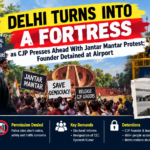
A protest march by Opposition MPs toward the Election Commission of India’s headquarters in Delhi turned into a tense standoff on Tuesday, 6 October 2026, after police blocked the group and detained several senior leaders, including Leader of the Opposition in the Lok Sabha Rahul Gandhi.
The march was the latest flashpoint in a weeks-long confrontation between the INDIA bloc and the Election Commission over the Special Intensive Revision of electoral rolls, a dispute that has also drawn in the Supreme Court in recent days.
What Happened on the Streets of Delhi
INDIA bloc MPs began their march from Parliament’s Makar Dwar gate, heading toward the Election Commission’s headquarters, Nirvachan Sadan. Congress president Mallikarjun Kharge, Rahul Gandhi, Priyanka Gandhi Vadra, Trinamool Congress MP Abhishek Banerjee and Samajwadi Party chief Akhilesh Yadav were among those who joined the march, according to news reports.
Delhi Police had tightened security around Parliament and the EC office in advance, putting up barricades at key points across central Delhi. The march was eventually stopped near the NITI Aayog building, well short of the Election Commission’s office, with police citing the barricades as the line protesters could not cross.
Rahul Gandhi’s Barricade Moment
As the march came to a halt, Rahul Gandhi climbed onto one of the police barricades and waved the national flag while other MPs gathered around him. Visuals of the moment, showing Gandhi standing atop the barricade with the Tricolour, were widely shared on social media and carried by multiple news agencies.
Protesters raised slogans including “vote chor, gaddi chhod,” loosely translating to “vote thief, leave your post,” directed at Chief Election Commissioner Gyanesh Kumar. Shortly after the standoff, Delhi Police detained Gandhi, Priyanka Gandhi Vadra and several other Opposition MPs, taking them away in buses, according to multiple reports from the scene.
What the Opposition Is Demanding
The protest centres on allegations that the Election Commission’s Special Intensive Revision of electoral rolls has led to flawed or biased voter list updates, a process the Congress and its allies have labelled “vote chori,” or vote theft. Kharge has said the party’s core demands are Gyanesh Kumar’s resignation, the annulment of the SIR exercise, and a return to paper ballots instead of electronic voting machines.
In remarks to reporters, Kharge argued that the government was undermining citizens’ voting rights and described the Commission as acting under government direction, a claim the ruling Bharatiya Janata Party has firmly rejected, criticising the Opposition’s broader campaign against the EC as unjustified.
Also Read – China Open Shock: Sabalenka Joins Rybakina on the Sidelines in Beijing
A Dispute Also Playing Out in Court
The street protest came a day after the Supreme Court weighed in on a related legal challenge. On Monday, 5 October, a bench led by Chief Justice of India Surya Kant clarified that the court had not approved changes made to Form 6, the statutory form used for registering new voters, contradicting an earlier Election Commission statement that had cited Supreme Court approval for the revised form.
The same bench declined an interim plea to suspend CEC Gyanesh Kumar but issued formal notice to the Election Commission and the central government on a petition challenging how the Commission arrives at its decisions, noting that such decisions must be either unanimous or by majority. The matter was tagged with an earlier related petition for further hearing.
Background: How the Standoff Built Up
Tensions between the Opposition and the Election Commission have been building since the rollout of the Special Intensive Revision of electoral rolls, which Congress and INDIA bloc partners say has resulted in large-scale, improperly conducted deletions from voter lists in several states. The Election Commission has defended the exercise as a routine and necessary clean-up of the rolls.
The dispute escalated further after a CEC press conference in which Kumar pushed back on the “vote chori” allegations, asking the Opposition to substantiate its claims under oath within a set period or retract them. INDIA bloc floor leaders, at a subsequent meeting led by Kharge, discussed moving an impeachment motion against the CEC in response, alongside their continuing street protests.
Why This Confrontation Matters
The dispute touches on one of the more sensitive questions in Indian democracy: public confidence in the neutrality of the body that conducts its elections. For the Opposition, keeping the issue visible through street protests and parliamentary procedure is central to building pressure ahead of the Election Commission’s response to the Supreme Court’s notice.
For the government and the Election Commission, the challenge is managing both the legal proceedings now underway and a sustained public campaign questioning the Commission’s independence, at a time when the Commission’s own account of the Form 6 changes has already been contradicted by the Supreme Court’s remarks.
What Happens Next
The Election Commission and the central government are now expected to file their formal responses to the Supreme Court notice, after which the court will take up the substantive questions raised about the Commission’s internal decision-making process and the disputed Form 6 changes.
On the political front, Opposition leaders have indicated they intend to keep up pressure through further protests and parliamentary action, including the possibility of a formal impeachment motion against the CEC, while the BJP has shown no sign of altering its position that the campaign against Gyanesh Kumar is unwarranted.
Frequently Asked Questions
Why were Rahul Gandhi and other INDIA bloc leaders detained?
They were detained by Delhi Police after a march from Parliament toward the Election Commission’s headquarters was stopped at a police barricade near the NITI Aayog office, as part of a protest demanding CEC Gyanesh Kumar’s resignation.
What is the INDIA bloc protesting against?
The protest centres on the Special Intensive Revision of electoral rolls, which Opposition parties allege has led to improper voter deletions, and on changes made to Form 6, the voter registration form used during the exercise.
What did the Supreme Court say about Form 6?
The Supreme Court clarified that it had not approved the modified Form 6 used during the Special Intensive Revision, contradicting an earlier Election Commission statement, though it declined to suspend the CEC and instead issued notice on the matter.
What are the Congress party’s main demands?
Congress president Mallikarjun Kharge has listed three demands: the resignation of CEC Gyanesh Kumar, the annulment of the Special Intensive Revision, and a return to paper ballots instead of electronic voting machines.
How has the government responded to the allegations?
The Bharatiya Janata Party has rejected the Opposition’s allegations and criticised the INDIA bloc’s campaign against the Election Commission, maintaining that the Commission has acted within its mandate.




[…] Also Read- Rahul Gandhi Detained as INDIA Bloc March to EC Office Halted […]