India’s Supreme Court has tightened the country’s plan for front-of-pack food warnings. On Thursday, 26 November 2026, it directed the food regulator to require a separate red hexagon for each of high fat, high sugar and high salt. The court also criticised global food companies that reportedly follow different standards in different countries. The ruling is a major step for public health and a setback for food makers that opposed such labels.
What the Court Decided
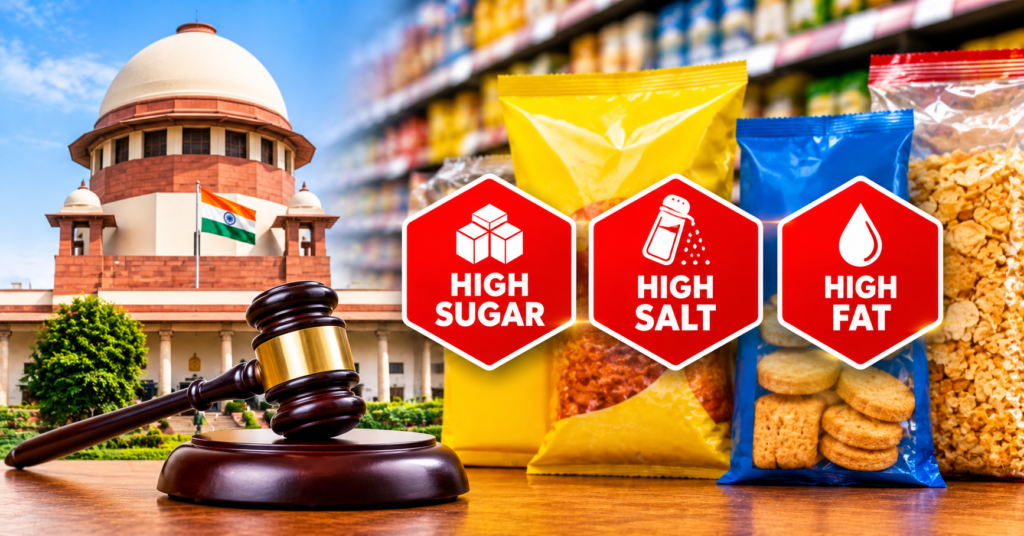
The Supreme Court directed the Union Government and the Food Safety and Standards Authority of India, or FSSAI, to introduce separate red hexagonal warning labels on packaged foods high in fat, sugar and salt. Each label must carry a standard pictogram of the nutrient along with the words “HIGH FAT”, “HIGH SUGAR” or “HIGH SALT”.
The order replaces the idea of a single combined warning. The judgment says the authority shall provide a separate hexagon for each nutrient of concern, rather than a single combined hexagon. The bench included Justices JB Pardiwala and K Vinod Chandran.
Ruling Highlights in Brief
- Separate warnings: one red hexagon each for high fat, high sugar and high salt
- Standard design: a pictogram plus the matching words on the front of the pack
- Measurement rule: The court directed FSSAI to base thresholds on total sugars and saturated fat, not added sugar and added fat.
- Sweeteners: The court also proposed a separate front-of-pack warning for products containing non-caloric sweeteners.
- Case history: The court had reserved its order on 28 September.
The Court’s Sharp Words on “Double Standards”
The judges did not hold back. Reports say the court criticised multinational companies that resist warning labels in India while applying such measures voluntarily in some other markets. It said global firms should apply uniform standards across countries, noting concerns that product composition can differ from one territory to another.
The court reportedly called such double standards “deeply troubling” if true. It added that an Indian consumer is entitled to no less protection or information than a consumer in the United States or the United Kingdom. The court did not name any company.
Who Brought the Case and Why
The challenge came from a non-profit group called 3S and Our Health Society. The group had pushed for stronger labels after the government’s plan was criticised as too weak. Its lead lawyer reportedly called the ruling a landmark development in the nation’s nutritional history.
The court also questioned the government’s approach during earlier hearings. It disapproved of the Union’s stand that India cannot follow international standards when issuing interpretative warnings of high sugar, sodium or fat content. The court tied the issue to obesity as a growing public health concern.
Also Read- World Stroke Day 2026: Why Minutes Matter, and What Every Indian Household Should Know
How Long This Fight Has Run
The debate is more than a decade old. A 2013 Delhi High Court order told FSSAI to frame rules on foods high in fat, sugar and salt. After years of consultations, FSSAI issued a draft labelling regulation in 2019.
A later plan drew criticism. A 2022 draft proposed an “Indian Nutrition Rating” based on a health star system. Critics argued that star ratings can still give a good score to products high in sugar, fat or salt, which is why health groups pushed for plain warning labels.
Reaction From Industry and Health Groups
Health activists welcomed the order. Reports said the global food companies that have long resisted such labels gave no immediate response. Industry executives have argued, in earlier debates, that warning labels may not work and could affect sales. Those arguments now face a strong court ruling.
Reports say the industry will get a year to adjust once the labelling law is finalised. Final timelines depend on FSSAI’s formal notification.
Why Red Hexagons Matter for Everyday Shoppers
Today, nutrition details often sit in small print at the back of a pack. A bold red hexagon on the front lets a shopper see at a glance whether a snack or drink is high in sugar, salt or fat. Separate labels also show which nutrient is the problem, so people can compare products quickly.
The change targets rising lifestyle diseases. India faces growing concern over obesity, diabetes and high blood pressure. Clear labels are meant to help families choose better, though they work best alongside general health awareness.
What Happens Next
- FSSAI action: The regulator must now frame or amend the regulations to match the court’s directions.
- Threshold setting: FSSAI will set the exact limits for sugar, saturated fat and salt.
- Company response: Food and beverage firms may react or seek clarifications once they review the full judgment.
- Adjustment period: Companies are expected to get about a year after the rules are finalised.
- Enforcement: The court has urged strict implementation, so watch for deadlines and monitoring.
Quick Answers on the New Food Warning Labels
What did the Supreme Court order?
Separate red hexagonal warnings on the front of packs for high fat, high sugar and high salt.
When was the ruling?
Thursday, 26 November 2026.
Who must implement it?
The Union government and FSSAI.
What nutrients will be measured?
Total sugars and saturated fat, not just added sugar and fat, along with salt.
Will labels appear on all foods?
Only on products that exceed the thresholds FSSAI sets.
When will the labels appear on shelves?
After FSSAI finalises the rules, with reports suggesting about a year for companies to adjust.