
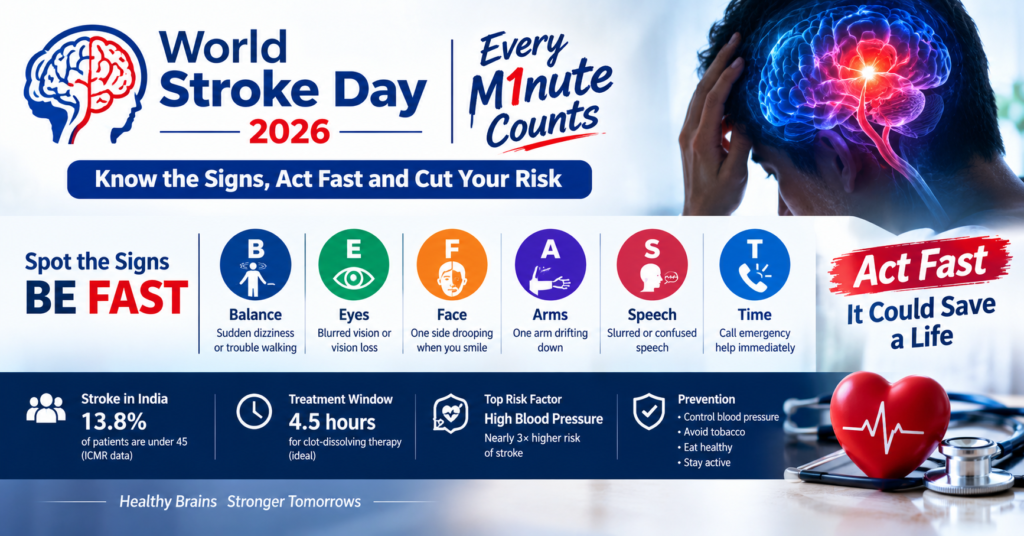
World Stroke Day is observed every year on 29 October. This year’s WSO campaign continues the theme “Every M1nute Counts,” paired with the #ActFAST call to action. The message is simple: recognise the signs quickly and get emergency help without delay.
The WSO is also marking 20 years of the World Stroke Campaign in 2026, and plans to announce a lived-experience advocacy award winner on 29 October.
What the Numbers Say
According to the WHO’s stroke fact sheet (updated in December 2025), stroke was the third leading cause of death and disability worldwide in 2021. There were 11.9 million new cases that year. The lifetime risk of stroke has risen by 50% over the past 20 years, and WHO says one in four adults is predicted to experience a stroke in their lifetime.
WHO says most of the burden comes from ten modifiable risk factors, including high blood pressure, smoking, high cholesterol and air pollution.
India’s Picture: Young Patients and Late Arrivals
India’s national stroke registry, led by ICMR, analysed 34,792 cases from 30 hospitals between January 2020 and December 2022.
Key findings reported from that data:
- About 13.8% of patients were under 45, roughly one in seven.
- Only 20.1% reached hospital within 4.5 hours of symptom onset, the window when clot-dissolving treatment works best.
- About 37.8% arrived more than 24 hours after symptoms began.
- One analysis found more than half of patients died or remained disabled within three months.
Delayed arrival was the main reason patients did not receive clot-busting treatment, according to coverage of the study. Doctors say symptoms are often dismissed as stress, migraine or tiredness.
How to Spot a Stroke: Use BE FAST
WHO lists the main warning signs as sudden loss of balance, sudden vision loss, facial droop, arm weakness and slurred speech. The BE FAST checklist covers these:
- B – Balance: sudden dizziness or trouble walking
- E – Eyes: sudden blurred vision or vision loss in one or both eyes
- F – Face: one side drooping when the person smiles
- A – Arms: one arm drifting down when both are raised
- S – Speech: slurred or confused speech
- T – Time: call for emergency help immediately
Symptoms that go away within minutes can signal a transient ischaemic attack (TIA), or “mini stroke.” WHO notes a TIA usually lasts only a few minutes and doesn’t cause long-term damage, but it still needs urgent medical attention because it can warn of a larger stroke.
Also Read- WPL 2027 Auction: Molineux Tops the Bidding as Five Teams Fill Their Final Slots
What to Do If You Suspect a Stroke
- Call emergency services at once. In India, 112 is the national emergency number, and many states also run 108 ambulances.
- Note the time symptoms started, or when the person was last seen well. Doctors use this to decide on treatment.
- Don’t wait to see if symptoms pass.
- Don’t give food, drink or medicines unless medical staff tell you to.
- Avoid driving the person yourself if an ambulance is available.
WHO says suspected stroke should be treated as an emergency, with brain imaging (CT or MRI) done as soon as possible. For ischaemic stroke, clot-dissolving therapy should be given within hours of onset, and some patients may need a procedure to remove the clot.
Types and Causes of Stroke
An ischaemic stroke happens when a clot blocks blood flow to part of the brain. A haemorrhagic stroke happens when a blood vessel in the brain ruptures and bleeds.
WHO identifies high blood pressure as the leading contributor. People with hypertension face nearly three times the stroke risk of those without it. Tobacco use is linked to about two-fifths of stroke deaths among people under 65. Non-modifiable risks include age, a prior stroke, heart conditions such as atrial fibrillation, and chronic kidney disease.
Practical Prevention Steps
WHO recommends these steps:
- Control blood pressure through a healthy lifestyle and treatment where prescribed.
- Avoid tobacco and second-hand smoke.
- Eat at least five servings of fruit and vegetables daily, and cut back on salt, saturated fat and sugar.
- Aim for at least 150 minutes of moderate exercise a week.
- Manage diabetes, cholesterol and atrial fibrillation.
- Limit alcohol.
Do not stop prescribed medicines without talking to your doctor. People with existing conditions should ask their doctor which exercise is safe.
Recovery After a Stroke
WHO says rehabilitation should begin as soon as the person is medically stable, ideally within the first few days. It can include physiotherapy, occupational therapy, speech therapy and psychological support. Long-term effects can include movement problems, memory loss, depression and reduced independence.
A Policy Milestone
On 22 May 2026, the World Health Assembly adopted its first-ever resolution dedicated to stroke, titled “Reducing the burden of stroke: strengthening prevention, acute care, rehabilitation and health-system readiness.” WHO and the WSO-convened Global Stroke Action Coalition described it as a major step, and it asks countries to strengthen care across the whole pathway.
What Comes Next
Hospitals, NGOs and health groups across India are running awareness drives around 29 October. The next step is for countries to turn the resolution into national plans. For households, the immediate step is to learn BE FAST, check blood pressure regularly and know the nearest stroke-ready hospital.
FAQs
When is World Stroke Day 2026?
On 29 October.
What is the 2026 theme?
“Every M1nute Counts,” with the #ActFAST call to action, according to the WSO.
What are the main warning signs?
Facial droop, arm weakness, slurred speech, sudden balance problems and sudden vision loss.
What is the treatment window?
Clot-dissolving treatment works best within 4.5 hours, though some procedures can help later in selected cases.
Can young people have strokes?
Yes. ICMR registry data show about one in seven stroke patients in India is under 45.
What is a TIA?
A short period of stroke-like symptoms. It needs urgent medical attention.
How can I lower my risk?
Control blood pressure, avoid tobacco, stay active, eat well and manage diabetes and cholesterol.
This article is for general information and isn’t a substitute for professional medical advice