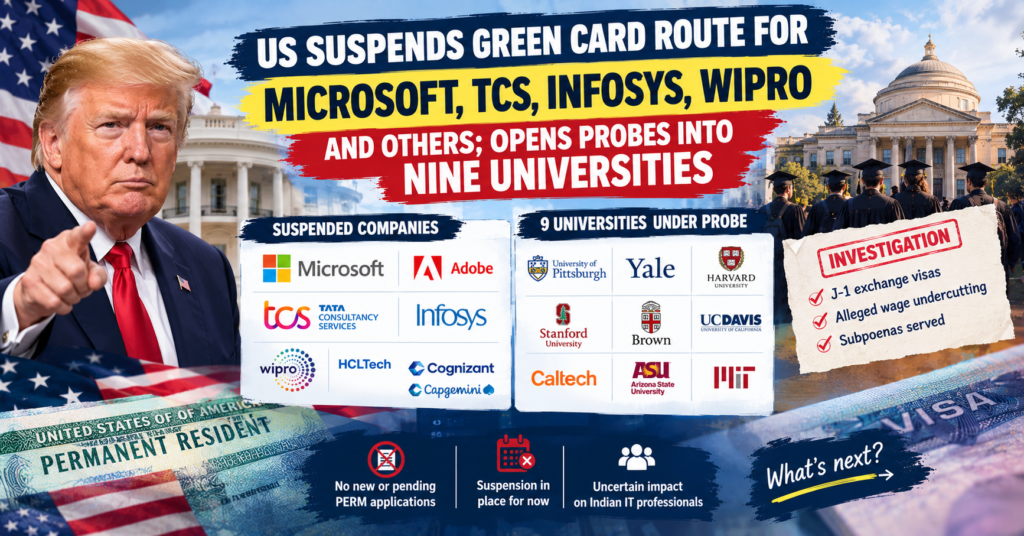
The United States has suspended Microsoft, Adobe and six major IT outsourcing firms from a key labour certification programme that employers use to sponsor foreign workers for green cards. On the same day, Thursday, October 8, 2026, the administration announced investigations into nine leading universities over their use of exchange-visitor visas.
The twin announcements, made at a White House press conference on visa fraud, mark one of the broadest actions yet against skilled-worker immigration pathways under President Donald Trump. For tens of thousands of foreign professionals, and for Indian IT companies in particular, the practical effect will depend on how the suspension is applied to pending cases.
What the Labor Department Announced
Labor Secretary Keith Sonderling said the department is suspending Cognizant, Infosys, Tata Consultancy Services (TCS), Wipro, HCL Technologies and Capgemini from the Permanent Labor Certification programme, known as PERM. He said Microsoft and Adobe are also being suspended because of multiple active federal investigations.
The department will not accept new applications, or process pending ones, involving these companies. Vice President JD Vance, who leads the administration’s anti-fraud task force, appeared alongside Sonderling and said the suspensions would last “as long as it needs to.”
Vance said the aim is to force the companies to change how they hire, alleging that some post job ads that are unlikely to succeed and then cite the lack of applicants to justify hiring lower-paid foreign workers.
Understanding PERM and Why It Matters
PERM is the step most employers must complete before sponsoring a foreign worker for an employment-based green card. Under the process, an employer has to show that hiring the foreign worker will not harm the wages or job prospects of US workers.
The suspension does not end H-1B visas, which are temporary work permits. But because PERM is typically the first stage on the road from an H-1B to permanent residency, blocking it can stall that path for workers at the named companies.
The Case Against Microsoft and the IT Firms
Vance singled out Microsoft, saying no company had abused the system more. He alleged that it laid off 6,000 American workers in 2025 while receiving more than 6,000 H-1B approvals. Reports differ on the exact green card and PERM figures he cited, so readers should treat those numbers as the administration’s claims.
Microsoft said about 80% of the roughly 6,000 H-1B applications it filed last fiscal year were to extend or change the status of existing employees rather than to hire new workers, and that it pays H-1B staff the same as other employees doing comparable work. Reuters reported that Microsoft is the largest filer of PERM applications, and that the company announced 4,800 job cuts in July, about 2.1% of its global workforce.
Sonderling said that since 2009 the six outsourcing companies have sought almost three million foreign workers and received more than 230,000 H-1B approvals and more than 100,000 permanent labor certifications. Vance used the phrase “visa mills” to describe firms that use the programme heavily.
Reuters noted that Vance’s remarks came hours before Trump honoured technology leaders, including Microsoft chief executive Satya Nadella, who once held an H-1B visa himself.
Nine Universities Face Scrutiny
The administration also announced investigations into the use of J-1 exchange-visitor visas at nine universities: Pittsburgh, Yale, Harvard, Stanford, Brown, UC Davis, Caltech, Arizona State and MIT. Labor Department Inspector General Anthony D’Esposito said subpoenas have already been served.
Vance alleged the universities use J-1 visas to undercut the wages of American graduate students and researchers, saying US workers in those roles earn roughly $20,000 more. D’Esposito said the schools use J-1 visas for federally funded grants at a rate of about 61%, compared with a national average of 38%.
STAT News reported it is unclear how much evidence supports the fraud concerns, and that the Inspector General’s office did not immediately explain the scope or timeline. MIT said it would cooperate with the investigation. Sarah Spreitzer of the American Council on Education warned of a major economic impact, noting that international students have historically spent about $40 billion a year in the US.
Reaction From Industry and Markets
Nasscom, India’s IT industry body, said Indian tech companies have significantly reduced their reliance on H-1B visas and that relatively few of their employees move to permanent residency through PERM. It said immigration and skilled talent mobility are separate issues. The Week reported that Indian professionals with pending PERM applications could still face delays if employers cannot proceed with filings.
Markets reacted unevenly. Bloomberg Law reported that Microsoft shares fell more than 1.3% in New York trading on Thursday, while Cognizant reversed early losses to rise more than 5%. Infosys ADRs recovered to gain over 1% after a sharp initial drop, and Wipro slipped less than 1%. Adobe, Cognizant, Infosys, HCL, Wipro and Capgemini did not immediately respond to Reuters requests for comment, and TCS declined to comment.
Background: A Widening Crackdown
The actions build on earlier steps. According to Reuters, the Labor Department launched an enforcement drive called Project Firewall last September as a White House proclamation imposed a one-time $100,000 fee on new H-1B petitions for workers hired from abroad. The administration has also clashed with Harvard over foreign students, and Harvard previously called an earlier Homeland Security subpoena “unfounded retribution.”
What Happens Next
No end date has been set for the suspensions. Key questions include how pending PERM cases will be handled, whether the companies will challenge the decision, and whether the Labor Department will extend similar action to other employers. The universities’ investigations are at an early stage, with subpoenas served but no findings announced.
Affected workers are likely to look to their employers and immigration lawyers for guidance in the coming days.
Frequently Asked Questions
Which companies were suspended from the PERM programme?
Microsoft, Adobe, Cognizant, Infosys, Tata Consultancy Services, Wipro, HCL Technologies and Capgemini.
What is PERM?
The Permanent Labor Certification programme, a step most employers must complete before sponsoring a foreign worker for an employment-based green card.
Does the suspension cancel H-1B visas?
No. It blocks new and pending PERM filings involving the named companies, which can delay the path from an H-1B to a green card.
How long will the suspension last?
Vance said it will last as long as it needs to, and no end date has been announced.
Which universities are being investigated?
Pittsburgh, Yale, Harvard, Stanford, Brown, UC Davis, Caltech, Arizona State and MIT, over their use of J-1 exchange-visitor visas.
How have Indian IT firms and Nasscom responded?
Nasscom said Indian firms have cut their H-1B reliance and that few of their workers use PERM, while TCS declined to comment and other companies did not immediately respond.