
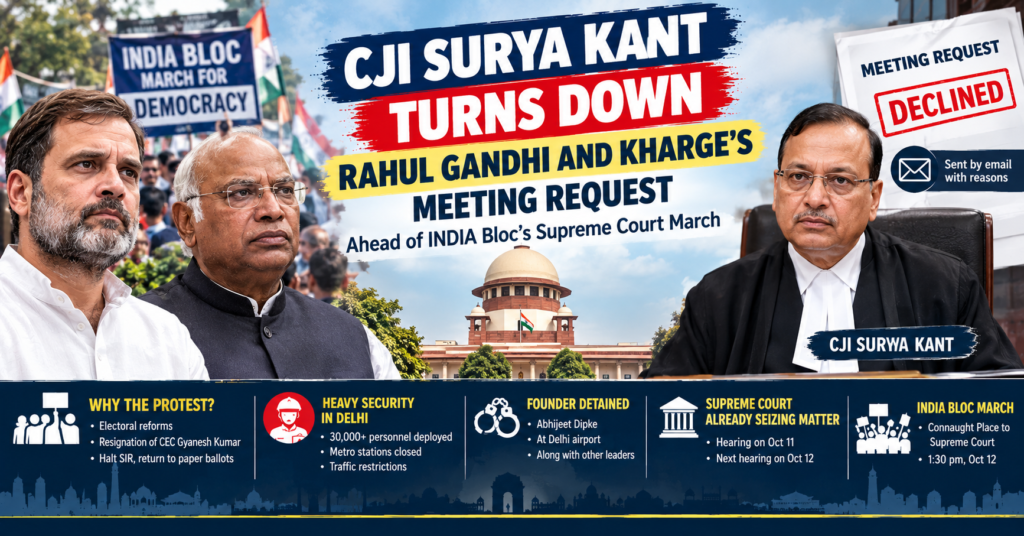
Chief Justice of India Surya Kant has declined a request from Leader of the Opposition in the Lok Sabha Rahul Gandhi and Rajya Sabha Leader of the Opposition Mallikarjun Kharge to meet him on Monday, October 12, 2026. The CJI’s office told The Hindu the request was “declined with reasons,” and the reply was sent to the leaders by email.
The refusal came hours before the INDIA bloc’s planned “Chalo Delhi, March for Democracy” rally from Connaught Place towards the Supreme Court, where the opposition wanted to submit a memorandum on alleged “vote chori,” the Special Intensive Revision (SIR) of electoral rolls and the conduct of Chief Election Commissioner Gyanesh Kumar.
What Happened
Gandhi and Kharge wrote to the CJI seeking a meeting between 4 pm and 5 pm on Monday to hand over a memorandum, according to PTI and Business Standard. Their stated demands were an end to alleged vote theft, the resignation of Kumar, a halt to the SIR and a return to paper ballots.
The CJI declined. Reports citing sources, including India Today, Aaj Tak and The Hindu, said the response was emailed to both leaders. The reasons were not issued as a public statement, so the details below come from sources.
Reasons Reportedly Cited
According to The Hindu’s sources, the meeting was declined because the issues likely to be raised were already sub judice in the Supreme Court. Sources also said the court cannot intervene in matters of governance and the administrative functioning of the state.
Congress sources told The Hindu the CJI also said meeting political parties would violate the separation of powers. Sources said he told the leaders they could raise questions on fundamental rights before the court on its judicial side, and that he expressed no view on the proposed march itself.
Also Read- Nikon Strips Top Prize From Microscopy Contest Winner After Video Breaks Generative AI Rules
The Court Is Already Hearing Related Matters
The Supreme Court has been dealing with the fallout of the protests directly. On Sunday, October 11, a special sitting of a bench of Justices Joymalya Bagchi and V. Mohana heard petitions alleging mass detentions, restrictions on public transport and internet services, and the treatment of women protesters and journalists after the October 10 demonstrations.
LiveLaw and The Statesman reported that the court directed that no one be detained except in accordance with the procedure established by law, particularly peaceful and unarmed people gathering outside areas where Section 163 BNSS prohibitory orders apply. It also ordered normal Metro and rail services and uninterrupted internet, subject to public order needs. The Statesman said contempt proceedings over the October 9 transport order are continuing, and The Hindu reported that petitions connected to the anti-CEC protests were listed for October 12.
What the March Involves
The Congress named Monday’s protest “Chalo Delhi, March for Democracy.” Leaders were scheduled to gather at the Connaught Place-Barakhamba Road junction at 1.30 pm before proceeding towards the Supreme Court, according to PTI and The Week. Gandhi said youth, opposition parties and civil society groups would join “united beyond party, gender, caste, community and state.”
Delhi Metro said entry and exit would remain closed at six stations, Patel Chowk, Janpath, Rajiv Chowk, Mandi House, Central Secretariat and Barakhamba Road, from 6 am to 4 pm. Delhi Traffic Police issued an advisory warning of restrictions and diversions from 6 am at about 30 locations.
Background: A Week of Escalating Protests
The standoff over the SIR has intensified over the past week. On Tuesday, October 6, INDIA bloc leaders marched from Parliament towards the Election Commission but were stopped, and Gandhi held an eight-hour sit-in at the Akashvani Bhawan complex. On Friday, opposition leaders marched from Parliament to Vijay Chowk and handed a memorandum to President Droupadi Murmu.
On Saturday, October 10, protests organised by the youth-led Cockroach Janata Party saw large-scale detentions and heavy security across Delhi. Gandhi said young people who protested peacefully were beaten by police and BJP supporters, an allegation that has not been independently confirmed in the reports reviewed. The Election Commission has denied that voter rolls are being manipulated, and Kumar has not publicly responded to calls for his resignation.
Reactions
The BJP had criticised the INDIA bloc’s plan to meet the CJI, NewsBytes reported. Other parties and commentators are likely to weigh in after the refusal and the march.
Why It Matters
The episode tests the line between political protest and the independence of the judiciary. By declining, the CJI kept the dispute within the court’s judicial process and away from a political meeting, while leaving the opposition free to take its arguments to the court through petitions.
It also puts the focus on how the Supreme Court will handle the pending cases on the SIR and on police action during the protests, which will shape the next phase of the campaign.
What Happens Next
The march is expected to go ahead from Connaught Place in the afternoon, subject to police arrangements and the court’s directions on peaceful assembly. The court is also due to hear petitions connected to the anti-CEC protests and the October 10 clampdown on Monday. Opposition leaders have not said what they will do with their memorandum now that the meeting has been declined.
Frequently Asked Questions
Did CJI Surya Kant refuse to meet Rahul Gandhi and Mallikarjun Kharge?
Yes. His office told The Hindu the request was declined with reasons, and the reply was emailed to the leaders.
Why was the meeting declined?
Sources said the issues are already pending in the Supreme Court and the court cannot intervene in administrative governance. Congress sources said he also cited the separation of powers.
What did Gandhi and Kharge want to submit?
A memorandum demanding an end to alleged vote chori, the resignation of CEC Gyanesh Kumar, a halt to the SIR and a return to paper ballots.
Is the march to the Supreme Court still going ahead?
Yes, the INDIA bloc said it would proceed, with leaders due to gather at Connaught Place at 1.30 pm.
Has the Supreme Court said anything about the protests?
On October 11, it directed that peaceful protesters not be illegally detained and that Metro, rail and internet services run normally, subject to public order.
Did the CJI comment on the march?
Sources said he did not express any view on the proposed march.




[…] Also Read- CJI Surya Kant Turns Down Rahul Gandhi and Kharge’s Meeting Request Ahead of INDIA Bloc’s Suprem… […]