
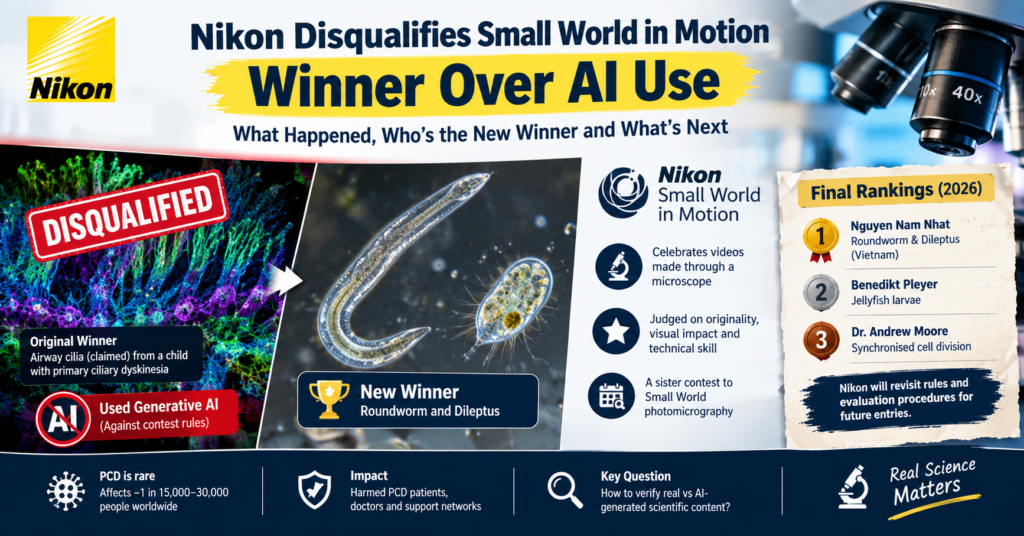
Nikon has disqualified the first-place video in its 2026 Small World in Motion competition, saying the entry did not comply with the contest’s rules on generative AI. The video, which claimed to show airway cilia beating in a child with a rare genetic disorder, drew criticism from scientists within weeks of being named the winner in September. The prize now goes to a video of a roundworm and a single-celled organism.
The decision, which was reported on October 9, 2026, adds a microscopy contest to the growing list of image and video competitions caught up in debates over AI-altered entries.
What Nikon Announced
Nikon Small World spokesperson Remi Yuter told Gizmodo that the company reached its decision after re-evaluating the video and supporting materials and consulting members of its judging panel. Nikon determined that the winning video “did not comply with the competition rules regarding generative AI.”
The contest rules, as reported by DPReview, do not permit AI-generated videos and allow the sponsor to request original footage for verification. Nikon said the ruling rests solely on the video’s eligibility and should not be read as a judgment of the entrant’s professional reputation, scientific contributions or intent. The company added that the episode shows the need to revisit rules and evaluation procedures for future entries.
The Video That Raised Alarms
The winning entry was submitted by optical researcher Ning Xu. It was presented as showing the abnormal beating of airway cilia, the tiny hair-like structures that line the airways, taken from a child with primary ciliary dyskinesia (PCD), a rare genetic disorder that affects breathing.
Experts began questioning the video soon after the win was announced. Gizmodo reported that they noticed structures that did not appear to exist in biology and that the clip carried an AI-identifying SynthID watermark. Robert Hirst, a University of Leicester scientist who has diagnosed PCD for 20 years, told the BBC that the cells in the video “look nothing like those from PCD patients,” according to DPReview.
What the Entrant Has Said
Gizmodo reported that Xu clarified that the video originated from actual research footage, but that he used generative AI for postprocessing. The BBC likewise reported that the winner acknowledged using AI. Xu did not respond to Gizmodo’s request for comment.
Nikon’s statement does not explain what role AI played, and DPReview noted that it leaves open whether the video was fully synthetic or an edit of real footage. Gizmodo said that regardless of intent, some coloured structures in the clip appear altered beyond recognition or fabricated.
The New Rankings
Nikon has updated the results. First place, which carries a $3,000 prize according to DPReview, now goes to Nguyen Nam Nhat of Chu Se, Gia Lai, Vietnam, for a video of a tiny roundworm and a single-celled organism called Dileptus exploring their microscopic world. His entry was previously in second place.
Second place goes to Benedikt Pleyer for a video of jellyfish larvae, and third place to Dr. Andrew Moore for a video of synchronised cell division in neighbouring cells. Xu’s entry no longer appears on the contest’s winners page, Gizmodo noted.
Background: A Contest Built on Real Science
Small World in Motion is run by Nikon Instruments and celebrates videos made through a microscope. It is a sister contest to Nikon’s long-running Small World photomicrography competition. Entries are judged on factors including originality, visual impact and technical skill.
PCD is estimated to affect roughly one in 15,000 to 30,000 people worldwide, according to a 2019 medical journal article. Because the structure and beating pattern of cilia are part of how the condition is diagnosed, specialists said they could spot problems in the clip quickly.
Why the Decision Matters
The case goes beyond a contest ranking. Hirst said the incident harmed PCD patients, doctors and support networks worldwide, Gizmodo reported. The article also quoted developmental biologist Melanie White of the University of Queensland, who earlier told Nature that scientific images are data and that scientists need to trust that they are grounded in the underlying measurement.
DPReview observed that tools designed to detect AI-generated content are imperfect, and that many rely on watermarks added by companies acting in good faith, which could be bypassed. That raises the question of how organisers can verify entries in future.
What Happens Next
Nikon says it will revisit the rules and evaluation procedures for Small World and Small World in Motion. It has not yet announced specific changes, such as mandatory submission of raw footage or new disclosure requirements. Xu has not publicly responded to the disqualification in the reports reviewed.
Frequently Asked Questions
What did Nikon do?
It disqualified the first-place video in the 2026 Small World in Motion competition for not complying with the contest’s generative AI rules.
Who won the competition originally?
Optical researcher Ning Xu, for a video said to show airway cilia from a child with primary ciliary dyskinesia.
Who is the new winner?
Nguyen Nam Nhat of Vietnam, for a video of a roundworm and a single-celled Dileptus.
Did the entrant admit using AI?
Gizmodo and the BBC reported that Xu said he used generative AI for postprocessing of real research footage.
Is Nikon accusing the entrant of misconduct?
No. Nikon said the decision is based solely on eligibility under the rules and is not a judgment of his reputation, scientific contributions or intent.
What happens next?
Nikon says it will revisit its rules and evaluation procedures for future entries.






[…] Also Read- Nikon Strips Top Prize From Microscopy Contest Winner After Video Breaks Generative AI Rules […]
[…] Also Read- Nikon Strips Top Prize From Microscopy Contest Winner After Video Breaks Generative AI Rules […]