
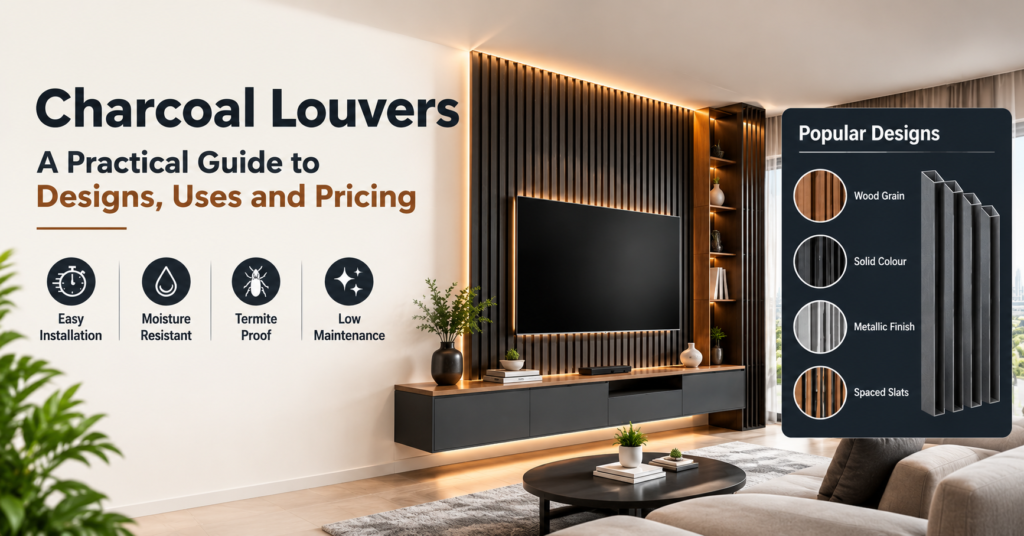
Charcoal louvers have moved from commercial showrooms into everyday Indian homes, and the reason is easy to see. These slim, vertical panels add depth, rhythm and texture to a plain wall without the cost and mess of carpentry, stone or heavy paneling. Designers use charcoal louvers to frame television walls, soften bare ceilings, wrap bed backs and divide open living spaces, while homeowners appreciate how quickly installers finish the job. This guide explains what charcoal louvers are, where they work best, how the common designs differ, what you should expect to pay and how to install and maintain them so the finish stays sharp for years.
What Are Charcoal Louvers?
Charcoal louvers are long, narrow decorative panels made from a composite core, which many manufacturers blend from bamboo charcoal fibre and polymer materials, then cover with a thin protective film. Factories press this mixture into grooved or fluted profiles, and those grooves give each strip its signature vertical ribbing. A typical strip measures about 8 to 9.5 feet in length and 5 to 12 inches in width, though sizes vary between makers. The surface carries a printed wood grain, a solid colour or a metallic tone, and a UV coating protects it against scratches and fading. Because the core does not soak up water the way plywood does, charcoal louvers usually resist moisture and termites, which suits humid cities and coastal homes.
Not every product sold under this name has the same core. A pvc charcoal sheet generally uses a polymer base that keeps the weight low and makes cutting easy, while a bamboo charcoal board adds fibre for extra rigidity. Many buyers use the terms charcoal panels, charcoal louvers and fluted panels interchangeably, but the louver form refers specifically to the slatted, rhythmic profile. Ask the seller for the core composition, the thickness in millimetres and the surface film type before you place an order.
Key Benefits of Charcoal Louvers
Homeowners choose this material for practical reasons as much as visual ones. These are the advantages that matter most:
- Fast installation: Most panels interlock or stick to the wall with adhesive, so a trained crew can finish an average feature wall in a single day.
- Moisture and termite resistance: The composite core does not swell or rot like raw timber, so panels hold their shape in damp rooms when you seal the edges properly.
- Low maintenance: You wipe the surface with a soft cloth, and you never need to polish, paint or re-varnish it.
- Wall flattering: The vertical grooves draw the eye upward and hide minor surface flaws on the wall behind.
- Light weight: Panels place little load on the wall, so they work on drywall, plaster and plywood backing alike.
- Wide finish choice: Buyers can pick from walnut, teak, oak, black, grey and metallic tones to match almost any palette.
Also Read- Wall Primer Paint: The Essential First Coat for a Flawless Finish
Popular Charcoal Louver Design Ideas
Charcoal louvers suit many rooms, and each placement creates a different effect. Consider these popular designs:
- TV unit backdrop: A tv unit charcoal sheet or a full run of louvers behind the television turns a blank wall into a focal point. Installers often add a hidden LED strip along the top edge so the grooves cast soft shadows at night.
- Feature wall in the living room: A floor to ceiling run of louvers in a walnut tone adds warmth, and pairing it with a plain painted wall keeps the room balanced.
- Bedroom headboard wall: Wrapping the wall behind the bed with charcoal panels creates a hotel style look and gives the room a calm, upholstered feel.
- Ceiling accent: Fixing louvers across the ceiling in a dining or entry area lowers the visual height and adds a layered effect, especially with cove lighting.
- Partition screen: Spaced louvers mounted between two frames divide a living and dining area while still letting light pass through.
- Entrance foyer wall: A narrow louver wall beside the main door gives guests a strong first impression and hides electrical boxes or shoe cabinets.
- Wardrobe and cabinet fronts: Designers often wrap the front of tall units with louvers so the storage blends into the wall like a single architectural surface.
- Staircase and passage walls: A continuous run along a staircase wall adds movement and makes a narrow corridor feel longer.
Colour and spacing change the outcome as much as placement does. Dark charcoal and black shades give a bold, modern look, wood tones feel warm and traditional, and light grey or beige tones keep small rooms bright. Tight, edge to edge installation looks smooth and contemporary, while spaced slats with a contrasting backing board create a more dramatic, layered pattern.
How to Choose the Right Panel
A good purchase begins with clear priorities. Check these points before you buy:
- Thickness: Panels between 8 mm and 12 mm feel sturdier and resist bending, whereas thin strips suit ceilings and low traffic walls.
- Width and length: Wider strips cover more area and reduce the number of joints, and longer strips avoid cut marks on tall walls.
- Surface film quality: Look closely at grain detail and ask about scratch and fade resistance, because cheaper films peel or dull under strong sunlight.
- Edge profile: Tongue and groove edges lock tightly and hide gaps, while plain edges need careful alignment.
- Fire and safety rating: Ask for any fire retardant claims in writing, especially for kitchens and children’s rooms.
- Warranty and sample: Request a small sample so you can test colour under your own lighting before you commit.
Understanding the Cost
Charcoal panel price in India depends on thickness, width, surface film, brand quality and your city. Current market listings show standard strips of about 8 to 9.5 feet in length and 5 to 6 inches in width selling between roughly ₹500 and ₹1,500 per piece, which works out to about ₹120 to ₹400 per square foot. Thin entry level PVC strips can cost less, while thicker 12 mm panels with wood grain or metallic films cost more. Installation labour, adhesive, trims, end caps and lighting add to the total, so ask your supplier for a written quote that lists material and labour separately. Prices change often, so confirm current rates with several local dealers before you budget.
Installation Steps
Good preparation makes the finished wall look professional. Follow this sequence:
- Measure the wall: Record the height and width, then add about ten percent for cuts and wastage.
- Prepare the surface: Clean the wall, fill cracks and let any moisture dry fully, because damp walls weaken adhesive.
- Fix a backing frame if needed: Uneven or old walls benefit from a thin plywood or wooden batten base that gives the panels a flat surface.
- Cut and fit the panels: Use a fine tooth saw, start at one corner with a spirit level, then lock each strip into the next.
- Finish the edges: Add trims, end caps and corner profiles, then run any LED strips and test them before you close the last panel.
Care and Common Mistakes
Maintenance takes very little effort. Dust the panels weekly with a dry microfibre cloth, wipe stains with a lightly damp cloth and a mild soap solution, and avoid harsh chemicals or abrasive scrubbers that damage the film. Keep naked flames and heavy heat sources away from the surface.
Buyers also make avoidable errors. Many skip the sample stage and regret the colour, others ignore wall moisture, and some forget to leave an expansion gap near the ceiling and floor. Avoid these mistakes and your charcoal louvers will look fresh for years.
Ready to plan “charcoal louvers” that suits your home? Explore more practical interior design guides, room ideas and home styling tips at FactIndia. Browse our latest articles and find simple, useful ideas to make every space feel comfortable, balanced and truly yours.
Frequently Asked Questions
Are charcoal louvers waterproof?
Most panels resist moisture well, but you should seal cut edges and avoid direct, constant water contact in bathrooms and open balconies.
Can I fix charcoal louvers on any wall?
Yes, you can fix them on dry plaster, brick, drywall or a plywood base, provided the surface is clean, flat and free of dampness.
How long do charcoal panels last?
With proper installation and gentle cleaning, quality panels commonly stay in good condition for many years, though lifespan depends on the product and room conditions.
Do they work for a TV wall?
Yes, a tv unit charcoal sheet or a full louver run suits television walls well, and you should leave ventilation space around any heat generating equipment.
Can I paint charcoal louvers?
Manufacturers finish most panels with a ready surface film, so painting is not recommended and may void the warranty.
What is the difference between PVC louvers and charcoal louvers?
PVC louvers use a plain polymer base, while charcoal louvers add charcoal fibre in the core for extra stiffness, so check each product’s specification sheet.





[…] Also Read- Charcoal Louvers: A Practical Guide to Designs, Uses and Pricing […]