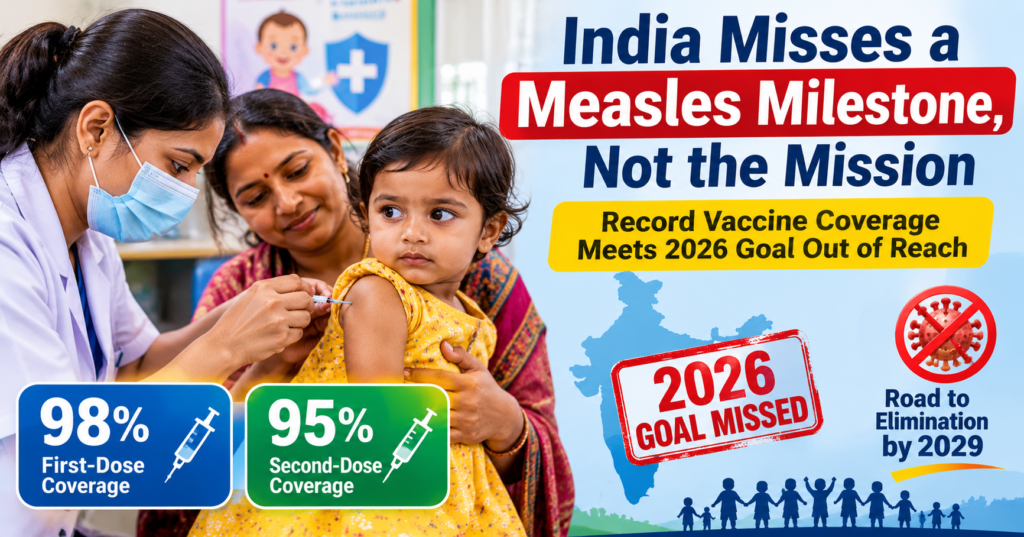
India has reached record measles vaccine coverage, yet the World Health Organization says the country will not meet its regional target of eliminating measles and rubella by 2026. The message arrived with a new global report on measles elimination, released this week. It is both good news and a reality check: India has made huge gains, but pockets of unvaccinated children keep the virus alive.
The Headline Finding
WHO experts said India is unlikely to meet the regional target of eliminating measles and rubella by 2026, despite “extraordinary gains” in immunisation. The projection came alongside the release of a report on progress toward measles elimination.
The experts did not describe a failure. They described a delay. Elimination requires more than high averages. It requires stopping local spread across every district and community.
India’s Measles Scorecard
- First-dose coverage: 98% for the first dose of measles-containing vaccine
- Second-dose coverage: 95%
- Global averages: 84% for the first dose and 77% for the second
- Cases in 2025: 17,995 reported measles cases, down from 65,150 in 2023
- Unvaccinated children: India fell out of the global top 10 for unvaccinated children for the first time since 2001.
- New timeline: transmission could be interrupted by 2029, with verification later
Why Strong Coverage Still Falls Short
Averages hide gaps. A WHO technical officer, Dr Santosh Gurung, said the 2026 case numbers remain high in pockets and certain areas of the country. A national figure of 98% can sit beside districts, villages or urban slums where far fewer children are protected. Measles is so contagious that a small unprotected group can sustain an outbreak.
The bar for elimination is high. A country must show it has stopped local transmission for three years in a row, according to the report. Even with the best coverage, India’s case numbers in 2025 and 2026 are too high to meet that test by the end of this year.
What WHO Officials Said
Dr Kate O’Brien, who leads WHO’s immunisation department, praised the effort. She said India’s improvement was hard-earned and the investment is now paying off. But she stressed the next task: keep coverage high and find the small groups of children still missed. In her words, the country remains at risk until it reaches everyone, no matter how remote the community.
She also warned against easing off. If investment falls, coverage will slip and children will again be left unprotected.
India’s Policy Push
The government set the 2026 goal in earlier years. The Union Health Minister launched a National Zero Measles-Rubella Elimination campaign for 2025-26 to push towards that goal. Officials at the time said many districts were already reporting zero measles cases. The new report shows that the campaign delivered big gains, even if the final target needs more time.
The Global Backdrop
India’s progress stands out against a mixed world picture. An estimated 10 million people were infected and 72,000 died of measles worldwide in 2025. Measles vaccination has saved an estimated 60 million lives since 2000.
Some countries have slipped. The United States lost its measles elimination status after outbreaks followed a drop in vaccination. The Americas saw an eight-fold rise in cases, with 73,000 infected in 2025.
Misinformation: A Rising Threat
WHO officials flagged false and confusing messages as a growing problem. Social media can amplify doubts among parents, and officials urged leaders in families, politics and religion to be clear that measles vaccines are safe and effective. Exposing a child to measles on purpose is dangerous, and even children who recover can have weaker immunity for a time, raising their risk of other infections.
Why Measles Is Taken So Seriously
Measles is among the most contagious infections known. It usually causes fever, rash and breathing-related symptoms, and it can lead to serious complications such as pneumonia and brain swelling. Young and undernourished children face the highest risk. High vaccine coverage protects both individual children and the community.
What Parents Should Know
Under India’s routine immunisation programme, children receive measles-rubella vaccine doses in their first two years. Parents should check the schedule with a doctor or local health worker and keep the vaccination card up to date. A child who missed a dose can usually catch up, so ask at the nearest health centre. For symptoms like high fever with a rash, seek medical advice promptly.
What Happens Next
- Sustaining coverage: Health authorities must keep immunisation rates high.
- Reaching missed children: Focus will turn to remote, urban poor and underserved communities.
- Surveillance: Better tracking of cases will show where outbreaks persist.
- Revised goals: WHO sees progress towards stopping transmission by 2029, followed by verification in the early 2030s.
- Tackling misinformation: Clear public messages will matter as much as supply.
Quick Answers on India’s Measles Progress
Will India eliminate measles by 2026?
No. WHO experts say the 2026 regional target will not be met.
What is India’s measles vaccine coverage?
98% for the first dose and 95% for the second, per WHO and UNICEF data.
How many measles cases did India report in 2025?
17,995, down from 65,150 in 2023.
What does elimination mean?
A country has stopped local transmission for three years in a row.
What was the other good news?
India dropped out of the global top 10 countries for unvaccinated children for the first time since 2001.
Is measles vaccine safe?
WHO says yes. Measles vaccines are safe and effective.